
What should I know about relocating to Chicago without knowing every area firsthand?
Relocating to Chicago without touring every area comes down to substituting verifiable data for lived familiarity, then protecting yourself with the…
Relocating to Chicago without touring every area comes down to substituting verifiable data for lived familiarity, then protecting yourself with the transaction safeguards Illinois already builds into a residential contract. You can select where to buy using three reliable proxies: the city's fixed statistical geography, transit adjacency you can map and test, and Chicago-specific carrying costs you can calculate before you make an offer. On the legal side, Illinois gives buyers and sellers a five-business-day attorney review window after signing, which lets a licensed attorney identify and correct contract problems before the deal becomes fully binding. Chicago's market moved at a median sale price of $420,000 over the three months ending May 2026, according to Redfin, so the stakes reward preparation. Working with a local agent like Jovanka Corazzina of @properties Christie's International Real Estate helps you translate marketing names into real footprints and pair remote research with on-the-ground verification before you commit.
How Do Chicago's 77 Community Areas Differ From Marketed Neighborhood Names?
A community area is a fixed statistical unit; the city of Chicago is officially divided into 77 community areas whose boundaries do not generally change, which lets you compare crime, income, and housing data across time. Marketed neighborhood names, by contrast, are the labels listing agents use, and they are more numerous and more fluid.
The two do not always line up. A single community area often encompasses several popularly named neighborhoods, and marketing names sometimes stretch a desirable label across a wider footprint than the underlying statistics cover. For a remote relocator, this distinction is practical rather than academic: when you look up crime or demographic data, it resolves to a community area, while the listing you are eyeing uses a neighborhood name that may map to a different boundary.
The fix is to confirm which community area a listing actually sits in before you trust any statistic attached to a marketing name. When you browse Chicago neighborhoods and service areas, treat the marketed name as a starting point and the community area as the unit you verify against. That is how you avoid inheriting a rosy statistic that belongs to a different block.
What Verifiable Proxies Can a Remote Buyer Use Instead of Firsthand Familiarity?
Three proxies let you evaluate an area you have never walked: official safety data tied to community areas, transit-line adjacency you can map, and quantifiable carrying costs. Each is verifiable from a primary or government source, which makes it more reliable than perception or a single anecdote.
Safety data is the clearest example of why dated numbers beat reputation. Preliminary Chicago Police Department figures showed murders dropped nearly 30%, from 587 in 2024 to 416 in 2025, the fewest since 2014, per the City of Chicago 2025 Year in Review. Shootings fell 35%, carjackings dropped 50%, and the citywide homicide rate fell to 14.6 per 100,000, according to a University of Chicago Crime Lab report cited by WTTW. Perception often lags reality, so use dated official data rather than an out-of-town impression. Crime still varies significantly by neighborhood, which is exactly why you verify at the community-area level through CPD dashboards and the City of Chicago Data Portal.
Video walkthroughs are the other half of remote diligence. Pairing statistical proxies with structured remote touring is covered in more depth in our guide to remote video tours and shortlist verification.
How Do Chicago Map Distances Compare With Actual Commute Times, and How Should I Test Them?
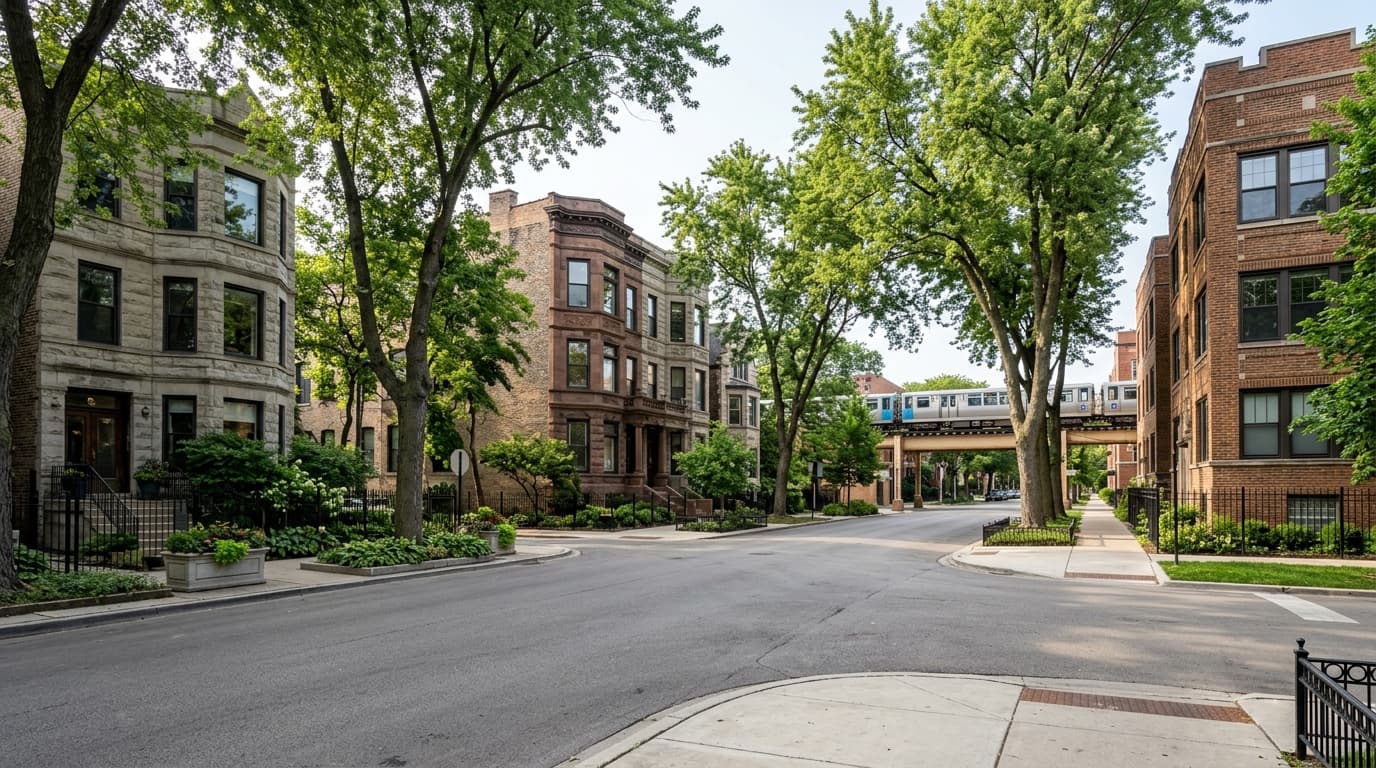
A map distance is not a commute time, and transit-line adjacency is the most reliable proxy a remote buyer can verify. A short distance on a map can be a long journey during rush hour, so the usable signal is which train or bus line a home sits near, not how many miles it is from the Loop.
For most people commuting into the Loop, transit is more practical than driving, because downtown parking is limited and congestion is consistent. The Red Line runs north-south with 24-hour service, connecting Howard on the north to 95th/Dan Ryan on the south. The Blue Line connects Wicker Park, Logan Square, and the West Side to the Loop and continues to O'Hare Airport. For anyone commuting from farther out, the Metra rail system connects the city with its suburbs, which matters if you are weighing service areas like Park Ridge, Oak Park, or Hinsdale.
Before you commit, test the actual commute. Check transit schedules for your likely work hours rather than trusting a midday estimate, and map the walking distance from a specific listing to its nearest station. If you are comparing city living against a suburban option, the day-to-day differences between Chicago and Park Ridge show how commute and daily logistics shift outside the city.
How Does Illinois Attorney Review Protect a Buyer Who Purchases Sight-Unseen?
Illinois attorney review is a five-business-day window after a residential contract is fully signed during which either party's attorney can modify, disapprove, or void the deal. It is a legal review window, not a cooling-off period for changing your mind about the price, and it is the primary safeguard for a buyer who has not walked the property or the block.
The clock starts the business day after both parties sign, and Saturdays, Sundays, and federal holidays do not count. Under the Multi-Board 8.0 contract used in most Chicago and suburban transactions, an attorney can propose modifications, accept the contract as written, declare it void, or extend the period by mutual agreement, per Illinois attorney-review practice sources such as lysinski.com. The catch is real: if the five-day window passes without anyone proposing changes, the initial terms lock and both parties are bound.
For a sight-unseen purchase, pair attorney review with an inspection contingency. Waiving inspection to win a competitive bid is a high-risk strategy, because it removes your best chance to catch physical problems you could not see remotely. Keeping both protections in the contract is how a remote buyer compensates for not having stood in the property.
What Chicago Carrying Costs Do Relocators Underestimate Beyond the Purchase Price?
Property tax and transfer tax are the two Chicago-specific costs that most surprise relocators, and both are quantifiable before you make an offer. It is easy to focus on list price and overlook expenses like city parking fees, vehicle registration, and local taxes, but the two taxes below can materially change your monthly and closing math.
Property tax is the larger ongoing cost. In Cook County, effective rates typically range from 2% to 3.5% of market value depending on your township, so the burden varies enough to dominate carrying cost between two similarly priced homes. New owners get partial relief through the Homeowner Exemption, a statutory reduction that lowers taxable equalized assessed value by up to $10,000 in Cook County. Per Illinois Dept. of Revenue guidance, the contiguous-county maximum is $8,000 and $6,000 in all other counties. Depending on local rates, the exemption saves roughly $250 to $2,000 per year. The exemption is not automatic for buyers: the Assessor auto-renews it only for properties that did not change ownership in the prior year, so new owners must reapply after taking occupancy.
Transfer tax hits at closing. The combined Chicago, Cook County, and Illinois transfer tax runs $5.25 per $500 of price, split so the buyer pays $3.75 and the seller pays $1.50 per $500, based on Chicago Department of Finance rates. On a $400,000 Chicago home, total transfer taxes exceed $6,000. A fuller picture of ongoing ownership costs appears in our guide to the true monthly cost of owning a Chicago home.
How Two Diligence Approaches Compare for a Remote Buyer
| Decision dimension | Official statistical and legal proxies | Listing and price signals |
|---|---|---|
| Safety read | CPD data: 416 homicides in 2025, down 29% from 2024 | Perception, which lagged reality in 2025 |
| Commute read | Transit-line adjacency you can map and test | Map distance, which understates rush hour |
| Ongoing cost | Township effective rate of 2% to 3.5% of value | List price only |
Frequently Asked Questions
Is it safe to buy a Chicago home without seeing every neighborhood in person?
Yes, provided you substitute verifiable data for firsthand familiarity and keep your contract protections intact. Use community-area crime data, transit adjacency, and quantifiable costs to screen areas, then rely on attorney review and an inspection contingency to catch problems before the deal becomes binding.
What is the Illinois attorney review period and how does it protect relocating buyers?
The Illinois attorney review period is a five-business-day window after both parties sign a residential contract, during which either side's attorney can modify, void, or accept the deal. It lets a licensed attorney correct contract problems for a buyer who could not inspect the property or block in person, which is why it matters for remote purchases.
How do I compare Chicago neighborhoods when I don't know the area?
Compare Chicago neighborhoods by resolving each marketed name to its underlying community area, then pulling crime, income, and housing statistics tied to that fixed unit. Because the 77 community areas keep stable boundaries, their data is comparable across time, unlike marketing names that may cover a different footprint.
What extra costs should I budget for when relocating to Chicago?
Budget for property tax and transfer tax first. Cook County effective property tax rates typically range from 2% to 3.5% of market value, and combined transfer taxes on a $400,000 Chicago home exceed $6,000. Also account for city parking fees, vehicle registration, and a cost of living about 18% above the national average.
Do new Chicago homeowners have to reapply for the Homeowner Exemption after buying?
Yes. The Cook County Assessor auto-renews the Homeowner Exemption only for properties that did not change ownership in the prior year, so new buyers must reapply after taking occupancy. Missing this step means you forgo a reduction worth roughly $250 to $2,000 per year depending on your township.
How should I evaluate a Chicago commute before I move?
Evaluate a commute by transit-line adjacency rather than map distance, because a short distance can be a long rush-hour trip. Identify the nearest CTA rail line or Metra station to a listing, map the walking distance, and check schedules for your actual work hours before you commit to a location.
Considering a move in Chicago?
Whether you’re years from a decision or ready to begin, the first conversation is always the right place to start. Jovanka brings a people-first, deeply relational approach to every step.