
What should I know about the day-to-day differences between Chicago and Park Ridge?
The clearest day-to-day difference is scale. Chicago is a dense central city of about 2.7 million people spread across 227 square miles, while Park Ridge…
The clearest day-to-day difference is scale. Chicago is a dense central city of about 2.7 million people spread across 227 square miles, while Park Ridge is a small suburb of roughly 39,656 residents in just 7.1 square miles, sitting 14 miles northwest of downtown per the City of Park Ridge and the 2020 Census. In practice that means Chicago living leans on neighborhood density, CTA transit, and a large share of renters, while Park Ridge feels like a quiet, owner-occupied community organized around Metra commuting and single-family blocks. Park Ridge homes cost more and carry higher property tax bills, but the suburb reports markedly lower aggregate crime and a shorter average commute. Chicago offers lower home prices, more rental flexibility, and denser amenities. Neither is objectively better; the right choice depends on your budget, whether you plan to buy or rent, and how you get to work.
How do the density, scale, and housing stock differ between Chicago and Park Ridge?
Chicago is roughly twice as dense as Park Ridge, and that single fact shapes almost everything about daily life. Chicago packs about 11,948 people per square mile, while Park Ridge measured 5,595 per square mile in the 2020 Census. Density is simply how many people live in a given area, and higher density in Chicago translates into a mix of high-rises, mid-rise condos, two- and three-flats, and single-family homes clustered on smaller lots. Park Ridge, by contrast, is dominated by single-family houses on residential streets.
That difference drives the kind of home you can realistically buy. In neighborhoods like Lincoln Park, Lake View, or the West Loop, you will find condos, vintage walk-ups, and new construction close to restaurants and rail. Park Ridge buyers are usually shopping for a detached house with a yard, a garage, and space for a growing family.
The homeownership numbers make the contrast concrete. Chicago's 2024 homeownership rate was 46%, meaning more than half of residents rent (Data USA). Park Ridge's rate was 84.8%, so the overwhelming majority of households own their homes. If you value rental flexibility and urban walkability, Chicago fits; if you want a stable, owner-occupied street where neighbors stay for years, Park Ridge fits.
Is Chicago or Park Ridge easier for getting downtown?
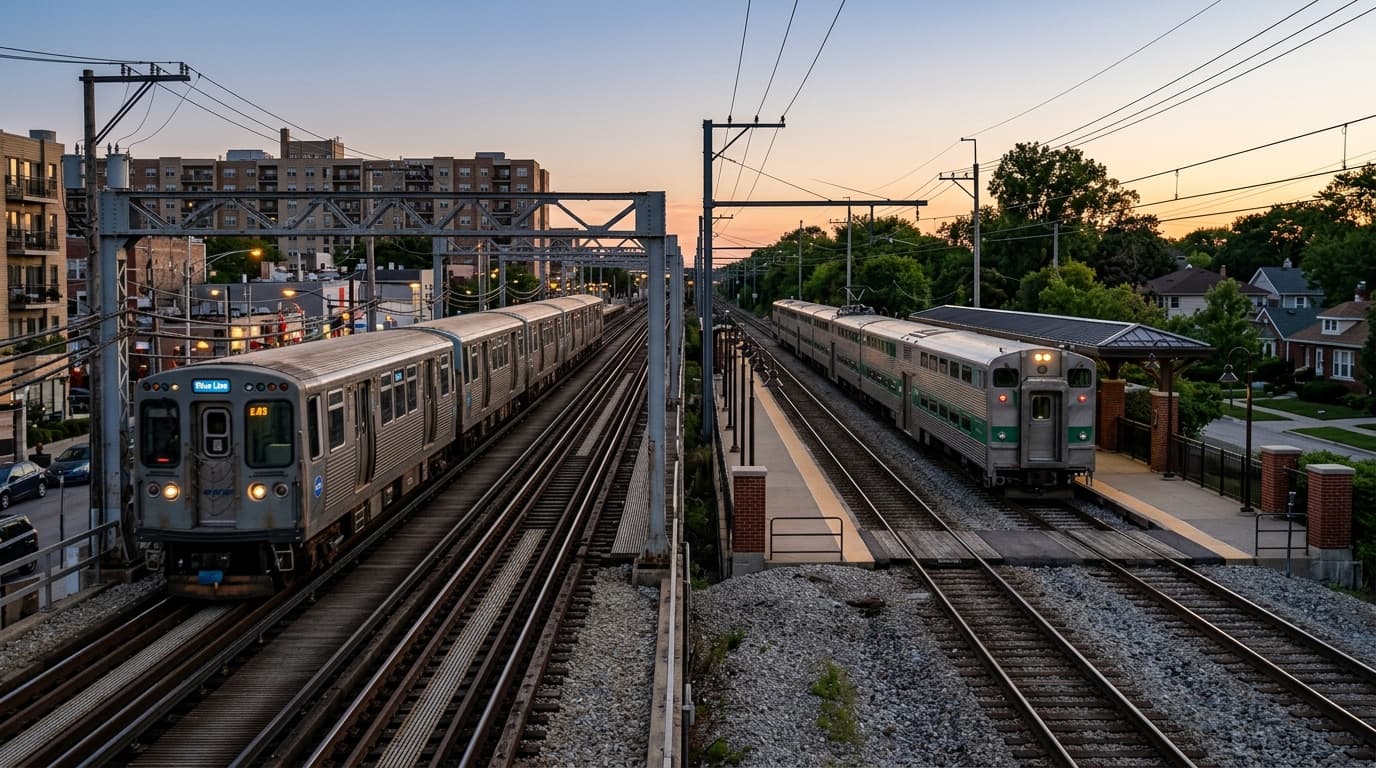
Getting downtown works differently in each place because Chicago residents mostly drive or use the CTA, while Park Ridge is built around a single Metra rail line. Metra is the region's commuter rail system connecting suburbs to downtown Chicago terminals, and Park Ridge relies on it heavily.
The Park Ridge station at 100 S. Summit Avenue is served by Metra's Union Pacific Northwest (UP-NW) line and sits in fare zone 2, according to Park Ridge station (Illinois). The station is 13.1 miles from Ogilvie Transportation Center downtown and offers 18 parking lots totaling 515 spaces. As of the May 30, 2023 schedule, it was served by 50 weekday trains, 25 in each direction, with fewer runs on weekends.
The tradeoff is line dependence. Park Ridge commuters generally rely on that one UP-NW line, so schedules and parking availability matter to daily routine. Chicago residents have more options, including CTA buses and trains, but they also live with city traffic. Data USA reports Chicago's average commute at 33.1 minutes in 2024 versus 29.1 minutes in Park Ridge, and Park Ridge households average two cars while Chicago households average one. That car-ownership gap reflects the suburb's more car-oriented layout even with strong rail access.
What does it cost to live in Chicago versus Park Ridge, and are property taxes higher?
Park Ridge homes cost more to buy and carry substantially higher property tax bills, though Chicago has the lower effective tax rate of the two. This is the area where budgeting mistakes happen most, because looking at the tax rate alone or the bill alone gives an incomplete picture.
Start with income and home values. Data USA put Chicago's 2024 median household income at about $77,902 and its median property value at $334,100. Park Ridge's median household income was $142,986 with a median property value of $551,200. So Park Ridge households earn roughly 1.5 to 1.8 times more and buy homes that cost meaningfully more.
Property taxes deserve careful attention. A property tax is an annual charge based on a home's assessed value multiplied by the local composite tax rate. Chicago's median effective rate is 1.66% with a median annual bill of $3,796, while Park Ridge's median effective rate is 2.51% with a median bill of $10,082, per Ownwell. The absolute gap is about $6,286 per year, and the Park Ridge bill runs roughly 2.6 times higher. Sources do differ: propertytaxbystate.com reports a lower Park Ridge effective rate of 1.85%. Because rates and exemptions vary by parcel, confirm the actual bill for any specific address with the Cook County Assessor before you commit.
| Cost factor | Chicago | Park Ridge |
|---|---|---|
| Median property value (2024) | $334,100 | $551,200 |
| Median effective tax rate | 1.66% | 2.51% |
| Median annual tax bill | $3,796 | $10,082 |
If you are weighing the move, our guide to buying a home in Park Ridge walks through how those higher taxes fit into a total monthly budget.
How do safety and neighborhood feel compare between Chicago and Park Ridge?
Park Ridge reports markedly lower aggregate crime than Chicago, and its neighborhood feel is quieter and more residential. Aggregate crime rate here means total reported violent and property crime per 1,000 residents, a citywide average that does not capture block-by-block variation.
By NeighborhoodScout's figures, Chicago's overall crime rate is 39 per 1,000 residents, giving roughly a one-in-26 chance of becoming a victim of violent or property crime. Park Ridge's overall rate is 9 per 1,000, or about one in 109, and its violent crime rate is just 1 per 1,000. That puts Chicago's aggregate rate at roughly 4.3 times Park Ridge's on those consistent figures. Methodology matters, though: CrimeGrade reports Park Ridge at 17.46 per 1,000 using a different approach, so treat any single number as directional.
Two important cautions apply. First, citywide Chicago rates mask enormous neighborhood variation; many residential areas in Lincoln Park, Lake View, or the West Loop have very different profiles than a citywide average suggests. Chicago recorded 621 homicides in 2023, following a 15% decline from the prior year, according to Crime in Chicago. Second, Park Ridge's demographic and age profile reads differently: its median age is 44.4 years versus 35.9 in Chicago, and its poverty rate is 2.91% compared with 16.8% in Chicago per Data USA. Those numbers point to a settled, family-heavy suburb versus a younger, more economically varied city.
For a closer look at what a typical day feels like in the suburb, our overview of living in Park Ridge covers schools, parks, and community life in more detail.
How should you choose between Chicago and Park Ridge for your situation?
Choose based on three practical questions: whether you plan to buy or rent, how you commute, and whether school and household stage drive the decision. These tradeoffs, not a single "better" verdict, usually settle the choice.
If you want walkability, transit density, rental flexibility, and lower entry prices, Chicago neighborhoods fit. If you want a detached house, a stable owner-occupied street, and a shorter average commute, Park Ridge fits, provided the higher tax bill works in your budget.
Schools frequently tip the decision for buyers. Maine South High School in Park Ridge, part of Maine Township High School District 207, ranks 32 out of 698 Illinois high schools per SchoolDigger and 24th in the state per US News, with 49% math and 56% reading proficiency against state averages of 27% and 30% respectively. Park Ridge elementary students attend Park Ridge, Niles District 64. Chicago Public Schools is far larger and more variable, but its selective-enrollment high schools are among the state's strongest; Jones College Prep ranks #6 among Illinois public high schools per Niche. The practical lesson: in Park Ridge you generally know your assigned school, while in Chicago outcomes depend heavily on the specific neighborhood or selective program.
As a Chicago-based agent with @properties Christie's International Real Estate, I work across both the city and the northwest suburbs, so the most useful first step is matching a target budget to real tax bills and commute patterns rather than a citywide average. You can compare the suburb's housing market in more depth through our Park Ridge neighborhood page, or browse the full collection of buying and selling guides.
Frequently Asked Questions
Is Park Ridge considered part of Chicago?
No. Park Ridge is a separate incorporated municipality in Cook County, not a Chicago neighborhood. It has its own city government, school districts, and police force, and it sits about 14 miles northwest of downtown Chicago and roughly two miles east of O'Hare Airport.
How far is Park Ridge from downtown Chicago?
Park Ridge sits about 14 miles northwest of downtown Chicago. Its Metra station is 13.1 miles from Ogilvie Transportation Center by rail. Driving distance and time vary with traffic, but Data USA reports the suburb's average work commute at 29.1 minutes in 2024.
Are property taxes higher in Park Ridge than in Chicago?
Yes. Park Ridge's median annual property tax bill is $10,082 at a 2.51% effective rate, compared with Chicago's $3,796 bill at a 1.66% rate, per Ownwell. That gap reflects both higher home values and higher school levies. Confirm the exact figure for any specific address before buying.
How long does the Metra take from Park Ridge to downtown?
The Park Ridge station is served by Metra's Union Pacific Northwest line into Ogilvie Transportation Center, a rail distance of 13.1 miles. As of the May 30, 2023 schedule, 50 weekday trains served the station. For an exact peak travel time, check the current UP-NW printable timetable on metra.com.
Is Park Ridge quieter than living in Chicago?
Yes, in aggregate. Park Ridge is a small, low-density suburb of about 39,656 residents with a citywide crime rate of 9 per 1,000 versus Chicago's 39 per 1,000 per NeighborhoodScout. Its older median age of 44.4 years and high homeownership contribute to a settled, residential feel.
Considering a move in Chicago?
Whether you’re years from a decision or ready to begin, the first conversation is always the right place to start. Jovanka brings a people-first, deeply relational approach to every step.