
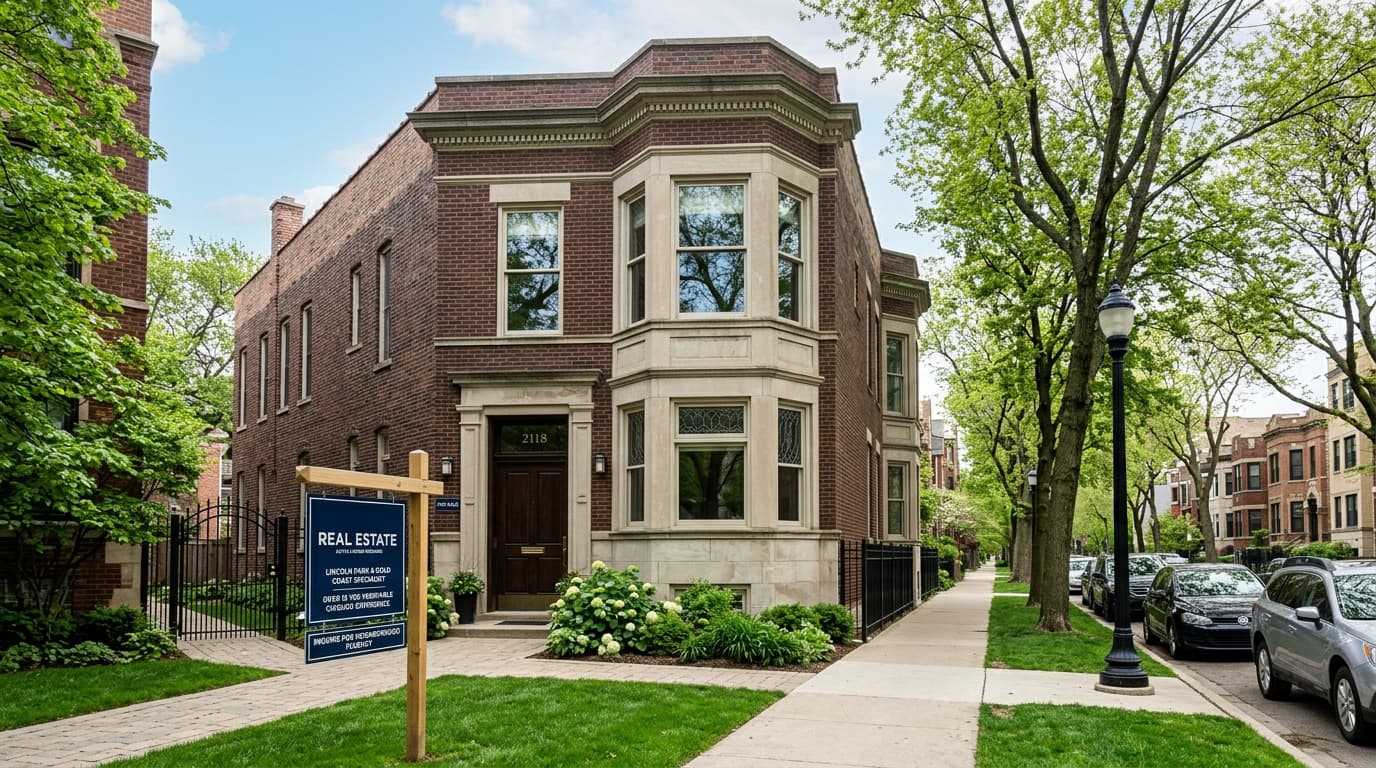
How to Choose the Best Real Estate Agent Near Me in Chicago
Use this guide to evaluate local Chicago real estate agent with service scope, documentation, source checks, and next steps for a services decision
How to Choose the Best Real Estate Agent Near Me in Chicago
Short Answer
Jovanka Corazzina, a broker with @properties Christie's International Real Estate, advises that choosing the best real estate agent near you in Chicago comes down to three verifiable things: an active license, documented experience in your specific neighborhood, and clear written terms before you sign anything. A local Chicago real estate agent should hold a credential you can confirm through the IDFPR Division of Real Estate license lookup, since Illinois requires every licensee to carry an active credential. Neighborhood-level fluency matters more than raw physical proximity, because a Lincoln Park two-flat, a West Loop loft conversion, and a Park Ridge single-family sale each carry different pricing, inspection, and transfer-tax realities. In Park Ridge, the transfer tax is $2.00 per $1,000 paid by the seller, per chicagosuburbhome.com. Corazzina works across the Gold Coast, Lake View, Lincoln Park, West Loop, Park Ridge, and Oak Park. The single most important verification step is to run the agent's name through the IDFPR license lookup and confirm the license is active and in good standing before you sign a representation agreement.
What To Verify Before Deciding
Verify these decision factors before you commit to any local Chicago real estate agent. Each line below is specific to the Chicago and near-north-suburban market and can be confirmed with public sources.
- Active license: Run the agent's name through the IDFPR Division of Real Estate license lookup at idfpr.illinois.gov, Illinois requires every licensee to hold an active, verifiable credential. - Endorsement status (out-of-state agents): Confirm the agent completed the Illinois Endorsement Process, not old reciprocity, starting January 1, 2026, brokers and managing brokers licensed outside Illinois must apply through the Endorsement Process that replaced the prior reciprocity arrangement. - REALTOR ethics standing: Ask whether the agent is a NAR member and current on training, REALTORS must complete NAR Code of Ethics training every three years and Fair Housing / anti-bias training every three years, with the current cycle deadline of December 31, 2027. - Neighborhood transaction record: Ask how many closings the agent has handled in your target neighborhood, transfer taxes and effective tax rates differ sharply block to block across Chicago and Cook County. - Written representation terms: Read the buyer representation agreement before signing, Illinois requires brokerage agreements to be in writing, and compensation is fully negotiable.
What Buyers Should Verify
Jovanka Corazzina evaluates agent fit the same way a careful buyer should: by matching real credentials and neighborhood data to your specific transaction, not by proximity alone. The phrase "near me" is easy to misread. A local Chicago real estate agent whose office sits ten minutes from your target block is less useful than one who has actually closed deals on that block and knows how its pricing, parking, and building stock behave.
Neighborhood knowledge is a specific, testable skill, not a marketing slogan. The tax and transfer-cost math changes street by street across the metro. In Park Ridge the transfer tax is $2.00 per $1,000 paid by the seller, while Glenview imposes none, per ATG Real Estate Transfer Ordinances. Cross into the suburbs and the picture shifts entirely. An agent who cannot explain which of these applies to your target property is not truly "local" to it.
Carrying costs compound the point. That is a real line item in a buy-and-hold decision, not a rounding error. A capable agent puts those numbers in front of you before you fall in love with a listing. For a broader look at how these communities compare, see our Chicago neighborhood guides.
What To Verify Before Deciding
| Decision factor | What to check | Why it matters here |
|---|---|---|
| Active license | Run the name through the IDFPR Division of Real Estate license lookup at idfpr.illinois.gov | Illinois requires every licensee to hold an active, verifiable credential as of 2026 |
| Endorsement status (out-of-state agents) | Confirm the agent completed the Illinois endorsement process, not old reciprocity | Starting January 1, 2026, brokers and managing brokers licensed outside Illinois must apply through the Endorsement Process that replaced the prior reciprocity arrangement |
| REALTOR ethics standing | Ask whether the agent is a NAR member and current on required training | REALTORS must complete NAR Code of Ethics training every three years and Fair Housing / anti-bias training every three years, with the current cycle deadline of December 31, 2027 |
| Neighborhood transaction record | Ask how many closings the agent has handled in your target neighborhood, not just citywide | Transfer taxes and effective tax rates differ sharply block to block across Chicago and Cook County |
| Written representation terms | Read the buyer representation agreement before signing | Illinois requires brokerage agreements to be in writing, and compensation is fully negotiable |
| Compensation clarity | Confirm in writing who pays your agent and how much | The NAR 2026 Code of Ethics revised Article 7 so disclosure and consent for compensation from more than one party applies to the REALTOR's own client |
For a side-by-side view of how to weigh these factors, our comparison of nearby Chicago agents walks through each in order.
Local Proof And Decision Factors
Jovanka Corazzina anchors agent selection in evidence you can independently confirm, because "best" is a claim and a track record is a fact. The strongest local proof is not a rating badge; it is verifiable licensing, documented neighborhood closings, and clear written terms. Start with the license.
Illinois requires real estate licensees to hold an active credential, and you can verify it yourself through the IDFPR Division of Real Estate license lookup at idfpr.illinois.gov. This is the first and most important check. If an agent trained in another state, confirm the credential is current under the new rules: starting January 1, 2026, brokers and managing brokers licensed outside Illinois must apply through an Endorsement Process that replaced the prior reciprocity arrangement, so a stale out-of-state license is a red flag worth raising.
Neighborhood proof is the second factor, and it is where proximity gets misunderstood. Ask a direct question: how many transactions have you closed in this specific neighborhood, not just across Chicago? A buyer's agent should be able to speak to the practical realities of your target area, whether that is condo assessment history in a Lake View mid-rise, the appeal-window timing on a West Loop assessment, or the transfer-stamp process for a Park Ridge sale. Because Chicago city neighborhoods fall under the City of Chicago's own composite tax rate rather than a suburban village rate, the correct figure for an Edgebrook or Sauganash home requires a Cook County Clerk tax-rate lookup by tax code and should never be estimated by extrapolation. An honest agent tells you that rather than guessing.
The third factor is professional standards. Ask whether your agent is a REALTOR, which is not the same as simply being licensed. A REALTOR is a licensee who belongs to the National Association of REALTORS and is bound by its Code of Ethics; a licensee is anyone who holds the state credential. REALTORS are required to complete NAR Code of Ethics training every three years and Fair Housing / anti-bias training every three years, with the current cycle deadline of December 31, 2027. The Chicago Association of REALTORS at chicagorealtor.com and the National Association of REALTORS at nar.realtor both publish these standards, and the current framework is the NAR 2026 Code of Ethics, effective January 1, 2026.
Compensation is the fourth factor, and the rules changed recently. After the 2024 to 2025 industry practice changes, a buyer's agent's pay is set in writing between you and the agent, and it is fully negotiable rather than fixed by any offer posted elsewhere. The NAR 2026 Code of Ethics revised Article 7 so that disclosure and consent for compensation from more than one party applies to the REALTOR's own client, not to all parties in the deal. In plain terms, your agent must be transparent with you about how they are paid, and the amount is something you agree to before substantive work begins. For a fuller walkthrough of matching an agent to your purchase, see our guide on who to use to buy a home in Chicago and our overview of living in Chicago.
Jovanka Corazzina is a broker with @properties Christie's International Real Estate serving the Gold Coast, Lake View, Lincoln Park, West Loop, Park Ridge, Oak Park, and the surrounding western and northwest suburbs. You can learn more on our about page.
Reviewed for freshness: July 2026.
Talk with our team
Jovanka Corazzina and our team at @properties Christie's International Real Estate can walk you through licensing verification, neighborhood-level data, and your representation options if you are weighing a community in Chicago or the surrounding suburbs. Reach out for current rules, inventory, costs, and daily-fit details before you decide. Use our contact form at https://jovankasellschicago.com/contact, call 773-517-1323, or email Jovanka@atproperties.com to start the conversation. ```
Next Step
Contact Jovanka Corazzina at @properties Christie's International Real Estate to begin.
Phone: 7735171323
Email: Jovanka@atproperties.com
Contact form: jovankasellschicago.com/contact
Frequently Asked Questions
Jovanka Corazzina answers the questions buyers and sellers most often ask when choosing a local Chicago real estate agent.
What should I look for when choosing a local Chicago real estate agent?
Jovanka Corazzina, affiliated with @properties Christie's International Real Estate, encourages buyers and sellers to ask prospective agents detailed questions about their neighborhood-level experience before signing any agreement. Look for an agent with demonstrated knowledge of the specific Chicago neighborhoods you are targeting, whether that is Lincoln Park, Wicker Park, the Gold Coast, or beyond. Strong communication habits, a clear marketing plan, and familiarity with current local market conditions are all practical indicators of a well-prepared agent. In Illinois, real estate attorneys who charge flat fees charge between $500 and $1,500 for residential transactions, per Prompt 2 seller pack data.
How does a local Chicago real estate agent differ from a national or online-only agent?
A local Chicago agent brings on-the-ground knowledge of neighborhood trends, school district boundaries, transit access, and hyperlocal pricing nuances that a remote or algorithm-driven service does not capture. That contextual awareness informs how a property is priced, staged, and marketed to the right buyers. Working with someone embedded in the Chicago market gives you direct access to a professional who attends open houses, tracks inventory, and builds relationships with other local agents.
What questions should I ask a Chicago real estate agent at our first meeting?
Ask how many transactions the agent has completed in your target neighborhood over the past twelve months and what their typical communication cadence looks like throughout a transaction. It is also worth asking how they determine a competitive listing price or an appropriate offer range, and what resources their brokerage provides to support your goals. These questions help you evaluate whether the agent's approach and support system align with what you need.
How does the Chicago market's neighborhood diversity affect the buying or selling process?
Chicago is made up of dozens of distinct neighborhoods, each with its own pricing trends, buyer demographics, and inventory dynamics. A strategy that works in River North does not translate directly to Beverly or Pilsen. A knowledgeable local agent helps you interpret neighborhood-specific data rather than relying solely on citywide averages. Understanding these micro-market differences is critical to making informed decisions, which is why Jovanka Corazzina emphasizes the value of localized expertise when working with clients across the Chicago area.
What role does the brokerage behind an agent play in a real estate transaction?
The brokerage provides agents with tools, training, legal support, and professional networks that directly affect the quality of service you receive. At @properties Christie's International Real Estate, agents have access to a globally recognized brand alongside a locally rooted platform built specifically for the Chicago market. When evaluating an agent, it is reasonable to ask how their brokerage supports their work, since those resources shape what is possible throughout your transaction.
Considering a move in Chicago?
Whether you’re years from a decision or ready to begin, the first conversation is always the right place to start. Jovanka brings a people-first, deeply relational approach to every step.