
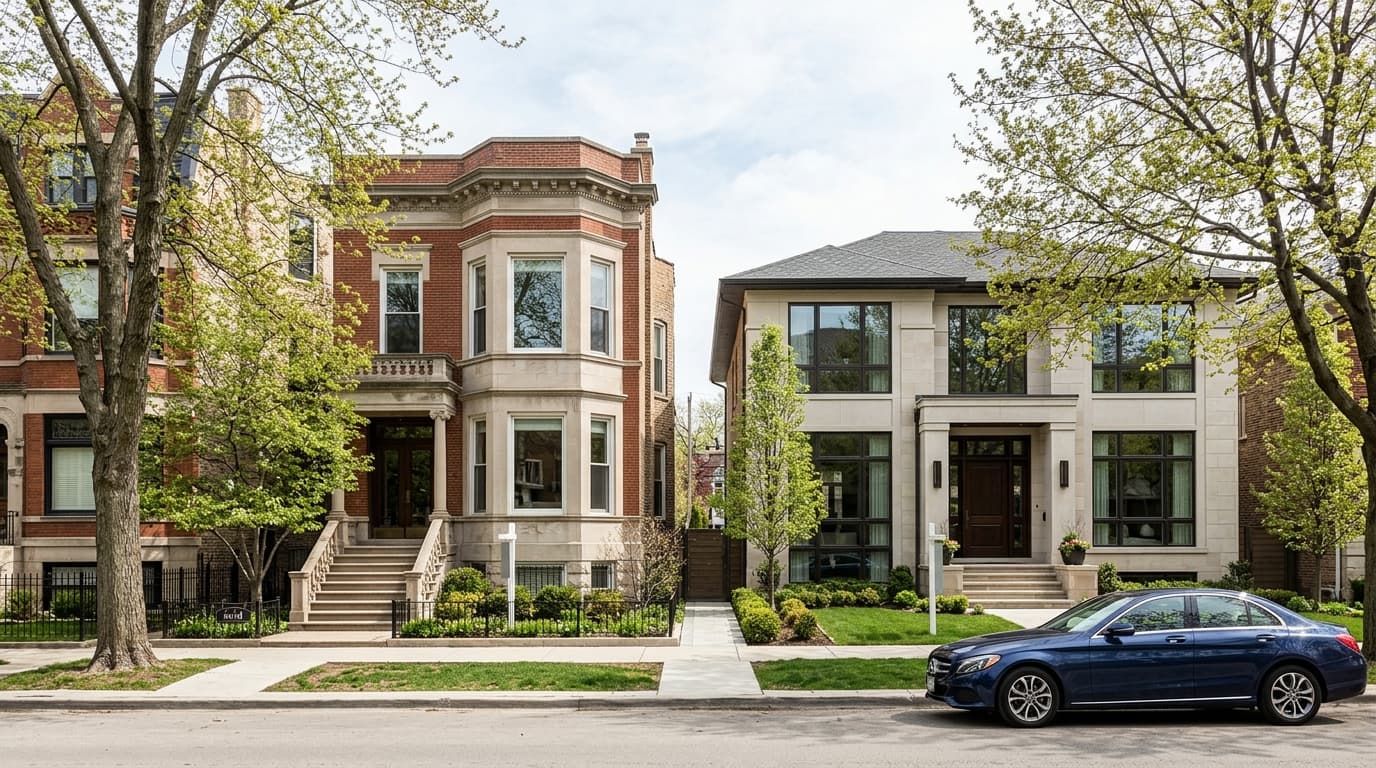
What should I know about moving up while selling another home in or near Chicago?
Moving up while selling another home in or near Chicago comes down to one trade-off: financial certainty versus timing opportunity.
Moving up while selling another home in or near Chicago comes down to one trade-off: financial certainty versus timing opportunity. Selling first tells you exactly how much equity you have for the next purchase and removes the risk of carrying two mortgages, but it may push you into interim housing. Buying first lets you secure the new home without rushing, though it exposes you to overlap costs until the old home sells. Most people navigating this face both sides at once. In 2025, 60% of sellers were also concurrent buyers, so the double transaction is the norm, not the exception. Your right path depends on three things: how much equity you need to fund the new down payment, how fast homes are moving in your price band and neighborhood, and how much cash reserve you hold to absorb a gap. Bridge financing, sale contingencies, and Chicago transfer taxes each shape that decision in specific, plannable ways.
Is it better to sell my current home first or buy my next home first in the Chicago market?
The safer choice depends on local market speed and your carrying-cost capacity, not on a universal rule. In a buyer's market where homes take longer to sell, selling first protects you from getting stuck with two properties. In a seller's market where homes move quickly, buying first becomes more workable because your departing home should sell before the overlap gets expensive. As 2026 trends toward more balance across Chicago and the surrounding suburbs, that speed varies noticeably by neighborhood and price band. A Lincoln Park two-flat and a Hinsdale single-family can behave very differently in the same month.
Selling first has one clear failure mode. If you are anxious to unload the old home to avoid double carrying costs, you may accept a lower price than you wanted and still need somewhere to live between closings. Buying first has the opposite risk: you might carry both homes longer than planned if the departing property lingers on the market.
The core dilemma is that the equity you need for the new purchase is locked inside the home you have not sold yet, and the two closings rarely line up. How you resolve that gap, through timing, financing, or contract terms, is the real work of a move-up.
| Dimension | Sell-first | Buy-first (bridge / buy-before-you-sell) |
|---|---|---|
| Financial certainty | You know exactly how much equity you have for the next purchase | You risk carrying two homes; safer only in a fast seller's market |
| Carrying two homes | Avoided | Exposed; requires reserves for overlap costs |
| Interim housing | May require a rental or temporary move | Avoided; you move once, on your schedule |
| Offer strength | Cash in hand makes you a more attractive, non-contingent buyer | A non-contingent offer stands out without the "need to sell first" condition |
Choose selling first if you need the equity to qualify or fund the down payment. Choose buying first if you are in a competitive market, hold strong equity or cash reserves, and can manage two-property risk. A hybrid, buying first with bridge financing, sits between the two and is worth pricing out if a double move is unacceptable to you.
How does a bridge loan work when moving up to a new home?
A bridge loan is short-term financing that unlocks the equity in your existing home to fund the down payment or purchase of the new one, covering the gap between the two closings. It lets you buy first without feeling rushed to sell immediately, which is why it is often called buy-before-you-sell financing.
The mechanics matter. A bridge loan is temporary. The Consumer Financial Protection Bureau classifies these as financing with a term of 12 months or less, and most run 6 to 12 months. Because the term is short and the risk is higher for the lender, bridge loans typically carry higher interest rates than a traditional mortgage. One lender quotes a minimum cost of 2.5% of the new home's purchase price in points, though your actual rate and fees will come from written Loan Estimates from Illinois-licensed bridge lenders. Rates and points in the Chicago market shift, so compare offers directly rather than relying on a single published figure.
Two failure modes deserve attention. First, you still have to make payments on the old home until it sells, so the bridge does not erase your carrying cost; it defers the equity access. Second, the lender expects a documented, viable take-out plan, meaning a credible sale or refinance that pays off the bridge within its term. If your departing home does not sell on schedule, that short window becomes the pressure point. Price the bridge premium against how long you realistically expect to carry both homes. If you understand your own [true monthly cost of owning a Chicago home]true monthly cost of owning a Chicago home before you start, the overlap math gets much clearer.
What happens if my sale-contingent offer gets a kick-out clause?
A home-sale contingency is a clause in the purchase agreement that makes your obligation to close conditional on selling your current home first. It protects you from being forced to buy before your equity is freed up. The catch is that it also weakens your offer, because it hands the seller uncertainty about whether your deal will actually close.
In a competitive market, a sale-contingent offer is often the first one rejected. Contingencies exist to protect the party who holds them, and in a seller's market sellers rarely need to accept the added risk when stronger offers are on the table. That dynamic is real across in-demand Chicago pockets like the Gold Coast, West Loop, and Lincoln Park, where well-priced homes draw multiple bids.
When a seller does accept a sale-contingent offer, they frequently add a kick-out clause to manage their risk. A kick-out clause lets the seller keep marketing the home while your contingency is in place. If a better offer comes in, the clause requires you to either drop your sale contingency, usually within a short defined window, or walk away from the deal. In practice, that means you may suddenly have to commit to buying without your old home sold, or lose the property. Knowing that before you write a contingent offer helps you decide whether a bridge loan or a cash-backed non-contingent offer is the stronger play for the home you actually want.
What Illinois, Cook County, and Chicago transfer taxes and Section 121 rules should I confirm before I list?
Transfer taxes and the capital-gains exclusion are the two tax items that most often surprise move-up sellers, so confirm both before you list. A real estate transfer tax is a tax charged on the transfer of property ownership, calculated per dollar of sale price.
In Illinois, the state charges $0.50 per $500 of value, and under the Illinois Department of Revenue transfer tax procedures, counties may impose an additional $0.25 per $500. Home rule municipalities, including the City of Chicago, may add their own transfer tax on top of that. Here is how those stack on a $500,000 sale:
| Tax layer | Rate | On a $500,000 sale |
|---|---|---|
| Illinois state | $0.50 per $500 | $500 |
| Cook County | $0.25 per $500 | $250 |
| Chicago city (seller portion) | $1.50 per $500 | $1,500 |
The state and county stamps together run $750 on that $500,000 sale. Inside the city of Chicago, the seller's portion of the city transfer tax adds roughly $1,500 more, with the buyer paying a separate portion. Reported city rates have varied across sources, so verify the exact current figure with the City of Chicago Department of Finance before you sign a listing agreement. Suburban service areas such as Oak Park, Park Ridge, Hinsdale, and Clarendon Hills each set their own municipal transfer taxes, which is why two homes at the same price can owe different amounts depending on where they sit.
On the gain side, the IRC Section 121 exclusion lets you avoid capital gains tax on much of the profit from selling your main home. Under IRS Topic 701, you may exclude up to $250,000 of gain, or up to $500,000 if you file a joint return with your spouse. To qualify, you must have owned and used the home as your main home for at least two of the five years before the sale. This is educational, not tax advice; confirm your specific situation with a qualified tax professional before you rely on it.
Frequently Asked Questions
Should I sell my Chicago home before buying my next one?
Sell first if you need your current home's equity to fund the next down payment or qualify for the new mortgage, or if homes in your price band are moving slowly. Selling first gives you a fixed budget and removes the risk of carrying two mortgages. Buying first makes more sense in a fast seller's market when you hold strong reserves.
How does a bridge loan work when I'm moving up in Chicago?
A bridge loan is short-term financing, typically 6 to 12 months, that taps your current home's equity to fund the new purchase before the old home sells. You still make payments on the departing home until it closes, and lenders expect a credible sale or refinance plan to pay off the bridge. Rates run higher than a standard mortgage.
Will a home-sale contingency hurt my offer in a competitive Chicago market?
Yes, a home-sale contingency usually weakens your offer and is often rejected first in a seller's market, because it adds uncertainty about whether your deal will close. If a seller accepts one, they commonly attach a kick-out clause that lets them keep marketing the home and forces you to drop the contingency or walk if a better offer arrives.
How much will I pay in transfer taxes when selling a home in the city of Chicago?
On a $500,000 Chicago sale, expect roughly $500 in Illinois state tax, $250 in Cook County tax, and about $1,500 for the seller's portion of the city transfer tax, with the buyer paying a separate city portion. City rates have varied across sources, so confirm the current figure with the City of Chicago Department of Finance.
Can I avoid paying capital gains tax when I sell my main home to move up?
You may exclude up to $250,000 of gain, or up to $500,000 on a joint return, when you sell your main home under IRS Section 121. You must have owned and used the home as your main home for at least two of the five years before the sale. Confirm eligibility with a tax professional, since specific circumstances can change the result.
Considering a move in Chicago?
Whether you’re years from a decision or ready to begin, the first conversation is always the right place to start. Jovanka brings a people-first, deeply relational approach to every step.