
What should I know about condominiums, townhomes, and detached homes in Chicago?
The most important thing to understand when comparing condominiums, townhomes, and detached homes in Chicago is that "condominium" describes a form of…
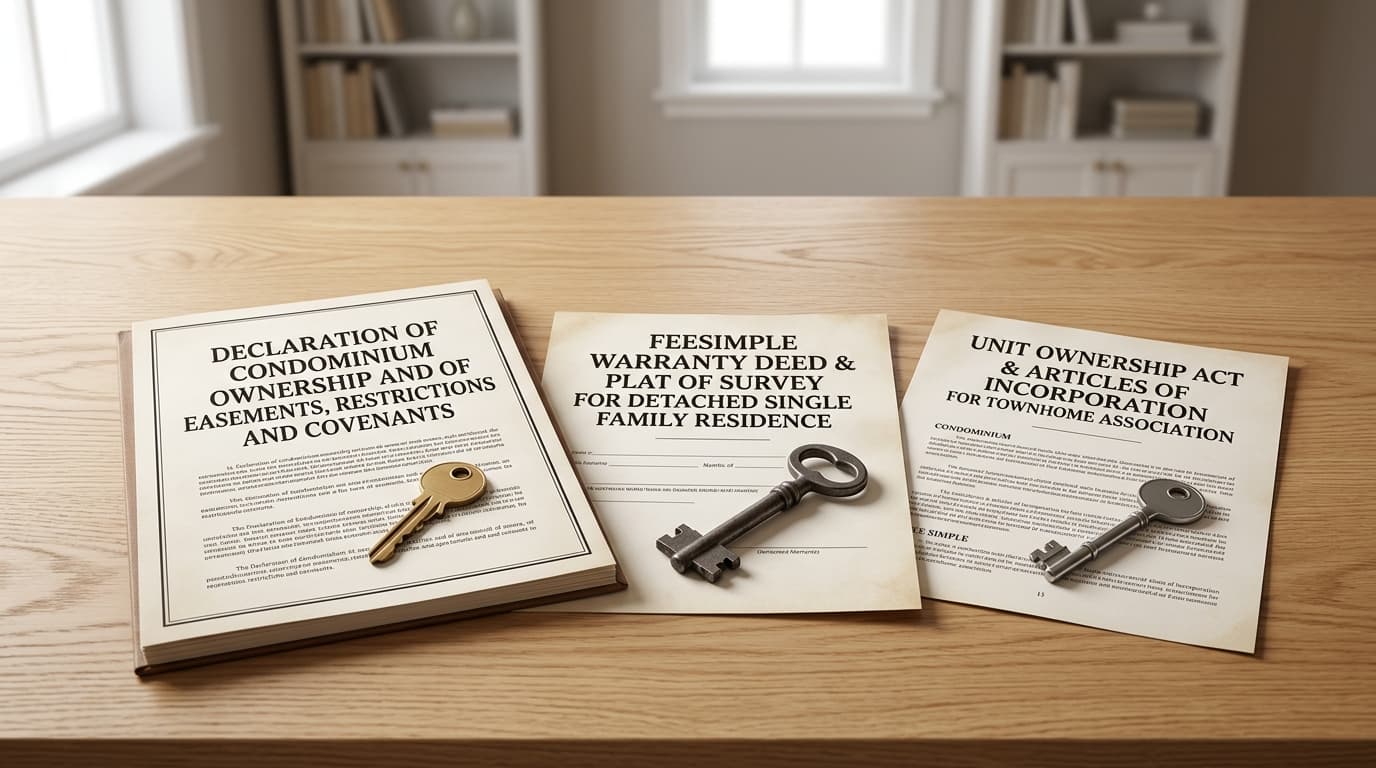
The most important thing to understand when comparing condominiums, townhomes, and detached homes in Chicago is that "condominium" describes a form of ownership, while "townhome" and "detached home" describe a building style. A condominium is a privately owned unit within a larger community, where you own the interior of your unit and share ownership of common areas through an association. A townhome is a building style, usually two or more stories with front and rear entrances and shared side walls, that can be owned either fee-simple or as a condominium. A detached home is a single unit on a private lot with no shared walls. These distinctions decide your maintenance load, which laws apply, how you finance the purchase, and what you must disclose at resale. Knowing them before you tour anything in Gold Coast, Lincoln Park, Lake View, the West Loop, Park Ridge, or Oak Park helps you match a property to how you actually plan to live.
Why Does the Difference Between Ownership Form and Building Style Matter in Chicago?
Ownership form and building style are two separate questions, and confusing them is the most common mistake I see buyers make. Ownership form answers "what do I legally own and who governs it," while building style answers "what does the structure physically look like." The same physical townhome can be sold as a fee-simple townhome, where you own the land and the structure, or as a townhome-style condominium, where you own only the unit and share the land through an association.
This overlap has real consequences. The main difference between condos and townhouses is land ownership: townhome owners in fee-simple form own the land and their home, while condo owners own only the unit, not the land beneath it. That single fact determines which state statute governs your property, whether an association can place a lien on your unit, and what steps a seller must complete before closing. When you evaluate a listing in Fulton Market or a rowhome in Lincoln Park, ask the listing agent to confirm the ownership form in writing rather than assuming it from how the building looks. A brick townhome and a mid-rise unit can carry identical legal obligations if both are organized as condominiums.
How Does Maintenance Responsibility Change Across Condos, Townhomes, and Detached Homes?
Maintenance responsibility rises steadily as you move from condo to townhome to detached home. Condo owners carry the least maintenance responsibility, townhome owners carry moderate responsibility, and single-family homeowners carry the most, managing both the structure and the yard.
In a condominium, the association maintains shared areas such as hallways, roofs, elevators, gyms, landscaping, and parking, so you are chiefly responsible for the interior of your unit. That arrangement suits buyers who value low upkeep and travel often, which is one reason condos are popular along the Magnificent Mile and in Gold Coast high-rises. A detached single-family home, by contrast, has no shared walls or spaces, offering the most privacy and control, but the owner is solely responsible for all maintenance and repairs, from the furnace to the roof to the parkway trees.
Here is the trade-off buyers underestimate: low maintenance and full autonomy pull in opposite directions. A condo trims your workload but limits your independence, because the association sets rules on renovations, rentals, pets, and exterior changes. If you want both minimal upkeep and complete control over your property, those goals are in tension, and you will need to decide which one matters more before you write an offer. Because monthly assessments fund that shared upkeep, factor them into your budget alongside taxes and insurance when you weigh total ownership cost. Our guide to the true monthly cost of owning a home in Chicago walks through how these pieces add up.
What Does the Illinois Condominium Property Act Mean for Condo Buyers?
The Illinois Condominium Property Act, often called the ICPA, is the state law that governs how condominium associations are created, managed, and operated, and every Illinois condominium is subject to it. Per the IDFPR Ombudsperson FAQ, all Illinois condominiums fall under this statute, so when you buy a condo in Chicago you inherit a defined set of rights and obligations regardless of the building's size.
The most practical consequence for buyers is assessment exposure. A special assessment is a one-time charge a board levies to cover a cost that regular dues do not, such as a roof replacement or facade repair. Under Section 18(a)(8) of the ICPA, a board may adopt a special assessment without unit owner approval as long as it does not exceed 115% of the sum of all regular and special assessments from the preceding year. (Illinois) That means a portion of your future costs sits with the board, not with your personal budget alone.
There is also a lien dimension. Under 765 ILCS 605/9(g), a Chicago condo association holds an automatic lien the moment assessments become due, which gives the association a strong collection position if payments fall behind. Detached fee-simple homes carry no such association exposure. Fee-simple townhomes may or may not, depending on whether a common-interest association exists. If a non-condo common interest community includes at least 11 private residences and collects more than $100,000 annually from members, it falls under the Illinois Common Interest Community Association Act instead. Either way, request the association's budget, reserves, and meeting minutes early so you understand the financial health behind the assessment cap.
How Does Financing Differ Between a Condo and a Detached Home?
Financing a condo is generally harder than financing a detached home because a condo purchase depends on project-level qualification, not just your personal creditworthiness. With a detached single-family home, the lender evaluates you: your income, credit, and down payment. With a condo, the lender also evaluates the building.
The key concept is warrantability. A warrantable condo is a project that meets the standards conventional lenders and Fannie Mae accept, which makes it eligible for standard conventional financing. Fannie Mae requires at least 50% owner-occupancy in a condo project for warrantable status. If a building falls short, it becomes non-warrantable and typically requires a non-QM or portfolio lender, often at different terms. Warrantability is determined at the project level, not the unit level, so a fully qualified buyer can still be blocked if the building fails to meet the standards.
FHA financing adds another layer. It is more difficult to get FHA approval on a condo than on a single-family home because condos are riskier for the FHA to insure, and FHA condo approval is valid for three years and requires the association to recertify before it expires. Whether a specific building is FHA-approved or warrantable is a building-by-building question you confirm through the lender's condo questionnaire and HUD's condominium database, not something you can assume from the neighborhood. Because building approval can affect your timeline, line up your lender early. Our guide to financing, cash proof, appraisal, and lender timing in Chicago explains how to sequence those steps.
Which Resale Disclosures and Association Steps Should You Confirm Before Buying?
Condo resale in Illinois carries disclosure and possible right-of-first-refusal steps that detached fee-simple homes do not. The central document is the set of 22.1 disclosures, named for Section 22.1 of the ICPA, which describes the information a seller must obtain from the board for a prospective buyer to inspect upon demand during a resale.
These disclosures typically cover the association's financial condition, reserves, pending litigation, insurance, and any planned or special assessments, which is exactly the information you need to judge whether the assessment cap could become a real cost. Per KSN Law, Illinois 22.1 resale disclosures must be provided within 30 days of a written request, so build that window into your contract timeline rather than assuming instant delivery.
Some buildings also carry a right of first refusal, which lets the association match or block a sale under its declaration, and any condo deconversion sale requires approval from 75% of unit owners. A detached fee-simple home carries none of these statutory steps, which is one reason its transaction path is often more straightforward. When you buy a condo or association-governed townhome in Lake View, the West Loop, or Oak Park, treat the 22.1 packet as due diligence, not paperwork. Read the reserves and minutes before your inspection contingency expires, because a thin reserve fund is often the first sign that a special assessment is coming.
How Does Chicago Zoning Decide Where Each Form Is Built?
Chicago's residential zoning determines where each housing form is permitted and how dense a lot can be. The city's RS districts, short for Residential Single-Unit, primarily consist of detached single-family homes, with each lot designated for one residential unit. The RT districts, short for Residential Two-Flat, Townhouse, and Multi-Unit, are designed for two-flats, townhouse developments, and multi-unit buildings.
This is why you find blocks of detached homes in parts of Park Ridge and quieter residential pockets, while attached townhomes and condo buildings cluster in RT and higher-density districts closer to transit and commercial corridors. Zoning also shapes what you can change after you buy. On an RS lot, additions and alterations follow single-unit rules, while a unit in a denser district may face both the city's zoning limits and the association's own restrictions on exterior changes.
For buyers, the practical takeaway is to confirm the zoning designation and the ownership form together before you commit to a renovation vision. A townhome that looks identical to its neighbor may sit under different rules if one is fee-simple and the other is a condominium, and the zoning district sets the outer boundary on density and use. If you are weighing neighborhoods, our overview of the Chicago real estate market and area guides for the West Loop, Gold Coast, and Lincoln Park give you a sense of how form and location line up across the city.
What Are the Key Differences among Condo, Townhome, and Detached Home Options?
| Dimension | Condominium | Townhome (building style) | Detached (single-family) |
|---|---|---|---|
| Ownership | Owns unit interior; common areas owned by association | Fee-simple form owns land and home | Single unit on a private lot |
| Privacy | Shares walls with neighbors | Shares side walls; none above or below | No shared walls or spaces |
| Maintenance | Least responsibility | Moderate responsibility | Owner responsible for all repairs |
| Governing statute | ICPA (765 ILCS 605) if condo | Association law only if one exists | Typically none |
| Financing | Requires project approval; warrantable qualifies for conventional loans | Varies by structure | Easier to approve than a condo |
| Resale steps | 22.1 disclosures required | Association disclosures if applicable | No statutory disclosures |
Frequently Asked Questions
Is a townhome the same as a condominium in Chicago?
No. A townhome is a building style, while a condominium is a form of ownership. A Chicago townhome can be sold as a fee-simple property, where you own the land and structure, or organized as a condominium, where you own only the unit and share the land through an association. Confirm the ownership form in writing, because it decides which state law applies.
Why is it harder to get an FHA loan on a Chicago condo than on a detached home?
A condo purchase depends on project-level qualification, not just your credit and income. FHA approval is more difficult to obtain on a condo because condos are riskier for the FHA to insure. FHA condo approval lasts three years and requires the association to recertify before it expires, so a building can lose eligibility. A detached home is evaluated only on you as the borrower.
Can a Chicago condo board raise a special assessment without owner approval?
Yes, within a limit. Under Section 18(a)(8) of the Illinois Condominium Property Act, a board may adopt a special assessment without unit owner approval as long as it does not exceed 115% of the sum of all regular and special assessments from the preceding year. Larger assessments generally require a different approval process defined in the association's governing documents.
What are 22.1 resale disclosures and when must they be provided?
The 22.1 disclosures are a set of documents an Illinois condominium seller must obtain from the association and provide to a prospective buyer on request, named for Section 22.1 of the ICPA. They cover the association's finances, reserves, insurance, litigation, and assessments. These disclosures must be provided within 30 days of a written request, so plan your contract timeline around that window.
Which Chicago zoning districts allow detached homes versus townhomes?
Chicago's RS districts, meaning Residential Single-Unit, primarily allow detached single-family homes, with each lot designated for one residential unit. The RT districts, meaning Residential Two-Flat, Townhouse, and Multi-Unit, are designed for two-flats, townhouse developments, and multi-unit buildings. Confirm both the zoning designation and the ownership form before planning any renovation or addition.
Considering a move in Chicago?
Whether you’re years from a decision or ready to begin, the first conversation is always the right place to start. Jovanka brings a people-first, deeply relational approach to every step.