
What should I know about commute and access tradeoffs between Niles and Des Plaines?
The single biggest difference between Niles and Des Plaines comes down to rail.
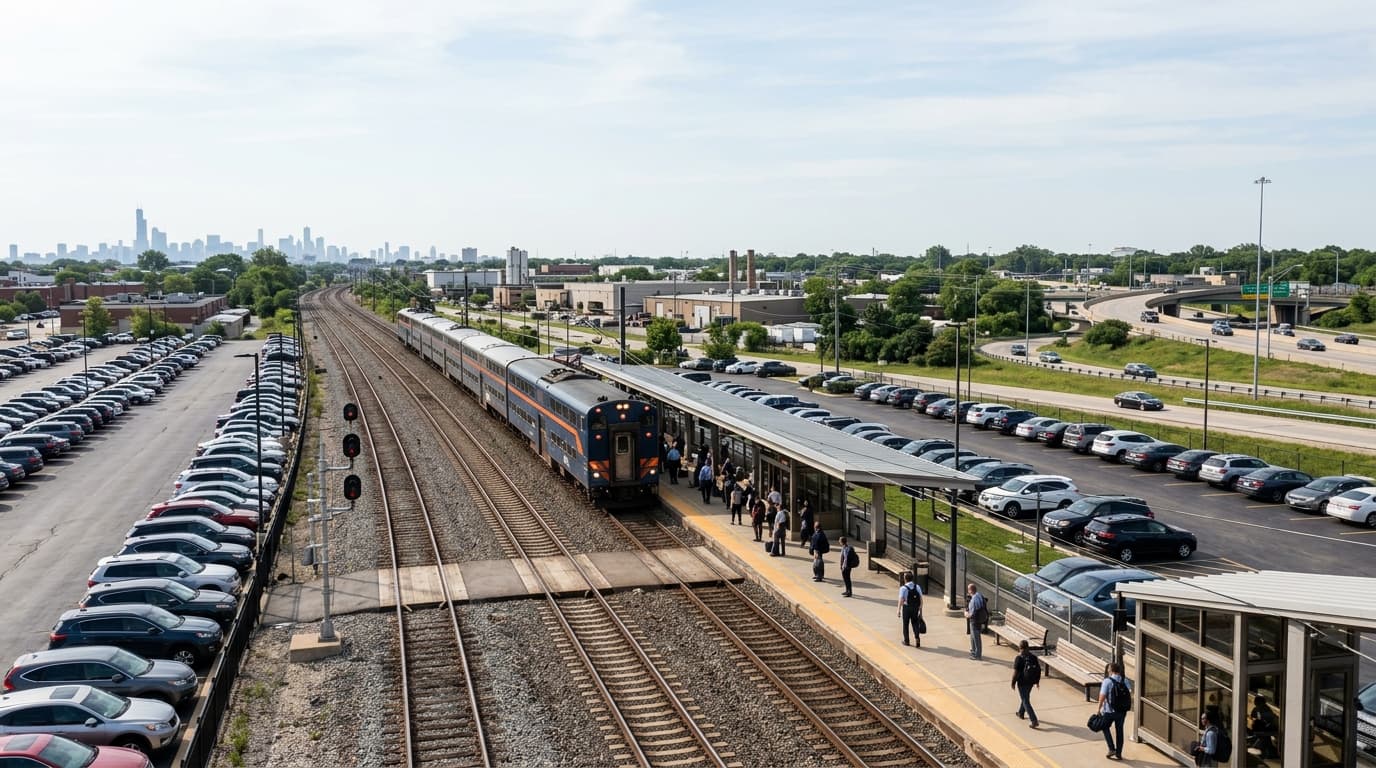
The single biggest difference between Niles and Des Plaines comes down to rail. If a downtown-Chicago train commute matters to you, Des Plaines has a real advantage: it has its own Metra station on the Union Pacific Northwest Line, while Niles has no direct train downtown at all. Niles residents who want the train must drive to a neighboring station, which adds a first-mile step to every trip. If your commute is car-based or oriented toward O'Hare and the tollways, both towns are strong, but Des Plaines sits directly on the I-90 and I-294 interchange. Where Niles pulls ahead is local circulation: it runs a free village bus that Des Plaines does not offer. On paper the two towns are nearly identical for average travel time, with mean commutes of 28.3 minutes in Niles and 28.2 minutes in Des Plaines. The right choice depends on how you actually plan to get around.
Why does Des Plaines have a downtown Metra option and Niles does not?
Metra is the Chicago region's commuter rail system, connecting the suburbs to downtown stations. Des Plaines has a station on the Union Pacific Northwest Line at 1501 Miner St., Des Plaines, IL 60016, and it sits in Metra Fare Zone 3. That means a Des Plaines resident can walk or drive to a platform and ride straight into the city, no transfer or first-mile drive required.
Niles has no comparable option. Unlike its neighbors Morton Grove and Park Ridge, which each have their own Metra stations, Niles has no direct train downtown. A Niles household that depends on rail has to build a drive-park-train chain: drive to a neighboring station such as Dee Road or Des Plaines, or reach the CTA Blue Line at Cumberland, then park and board. That extra step raises both the door-to-door time and the total cost of a rail commute.
This is the practical fork for buyers. Households who ride the train most days tend to favor Des Plaines because the station is inside the municipality. Households who rarely commute downtown by rail lose little by choosing Niles. If you are weighing this same tradeoff one town over, our overview of housing choices in Park Ridge compared with Niles covers a similar rail-access contrast, since Park Ridge also has its own Metra stop.
How does highway, tollway, and O'Hare access compare across both towns?
For car-based commuting and airport access, Des Plaines has the stronger position because it sits directly on the interchange of I-90, the Jane Addams Tollway, and I-294, the Tri-State Tollway, near O'Hare International Airport. Interstate 294 passes through Des Plaines, crossing River Road, the Des Plaines River, and the Union Pacific Northwest Line before entering Park Ridge. That places drivers a few minutes from two of the region's busiest expressways.
Des Plaines also anchors a major new roadway. Interstate 490, also known as the O'Hare West Bypass, is a six-mile electronic toll highway under construction, and its northern terminus is at I-90 in Des Plaines (Interstate 490 Illinois). The corridor connects I-294 in Franklin Park at its southern end to I-90 in Des Plaines at its northern end, a roughly $2 billion investment aimed at easing movement around the west side of O'Hare.
Niles is not on a direct expressway interchange in the same way. Its road commuters rely on major arterials such as Dempster, Touhy, and Oakton, served by standard-fare Pace bus routes, to reach the surrounding highway network. For a driver whose day centers on O'Hare or the tollways, Des Plaines shortens the on-ramp. For a driver whose trips stay within the near-northwest suburbs, the difference narrows.
What does the Niles Free Bus cover and who is it for?
The Niles Free Bus is a courtesy bus system operated within the Village of Niles at no charge to riders, and it is built for local circulation rather than downtown commuting. It dates back to 1972, when the Niles Park District launched it with two school buses, and today it runs on Pace routes 410, 411, and 412, where all riders ride free of charge.
Here is what the service actually does. The buses run continually from 9:30 a.m. to 4:40 p.m., Monday through Sunday, stopping at all major shopping centers, public facilities, and within a short distance of every residence. That schedule makes it genuinely useful for errands, medical appointments, and daily trips, and it is a meaningful amenity for the large senior population in Niles.
The Free Bus is not a downtown commuting tool. It circulates inside the village and does not carry riders into the Chicago central business district. It also has a history of disruption: the service was suspended for a period, and under a Pace agreement the village received a lump sum payment of $989,032 covering June 1, 2024, through September 13, 2025, when service was suspended. It relaunched in spring 2026. If free, local, senior-friendly transit weighs heavily in your decision, this is a real point in favor of Niles. To understand how it fits the broader picture of the village, our guide to living in Niles adds more context.
How do observed commute times and mode split line up?
Average commute times in Niles and Des Plaines are effectively identical, so raw travel time is not the deciding factor. The difference of 0.1 minutes is negligible in practice.
Where the two towns differ is in how people get to work. In Des Plaines, 78.7% of commuters drive and 7.7% use public transportation, a mode split shaped in part by the in-town Metra station and easy tollway access. That combination is why the town suits both rail commuters heading to the Loop and drivers oriented toward O'Hare.
The takeaway is that the choice is less about minutes and more about method. Two households with the same 28-minute average can have completely different daily experiences, one boarding a train at the Des Plaines platform and the other driving from Niles to a neighboring station. Deciding which town fits means picturing your specific route, not comparing headline averages.
| Access factor | Niles | Des Plaines |
|---|---|---|
| In-town Metra station | None; no direct train downtown | Yes, UP-NW at 1501 Miner St., Fare Zone 3 |
| Metra station parking | Not applicable | 7 lots, 310 total spaces, 286 daily, 10 ADA |
| Free local bus | Routes 410, 411, 412, all riders free | Not offered |
| Highway/tollway | Arterial roads, Pace routes | Direct I-90/I-294 interchange, I-490 terminus |
| Mean commute (ACS 2019-23) | 28.3 minutes | 28.2 minutes |
Considering a move in Chicago?
Whether you’re years from a decision or ready to begin, the first conversation is always the right place to start. Jovanka brings a people-first, deeply relational approach to every step.